
...this morning from a person. Along with some extras as well as a 100 rounds of ammo for it. I will be taking it out with me to my wilderness place as soon as the vet gives my dog a clean bill of health.
-
When you're running down my country hoss...you're walking on the fighting side of me!
FOR THE LYING LOWLIFE POSTING AS PATHFINDER...http://gfy.com/fucking-around-and-pr...athfinder.html -
What's up with the dog? -
you hunting bear?TRUMP 2026 KEKAW!!! - The Laken Riley Act Is Law!
DACA ENDED - SUPPORT AZ HCR 2060 52R - email: brassballz-at-techie.comComment
-
He hurt himself when we were out at the wilderness place. He could not walk properly ...could not jump and was in some pain...so we came in and I took him to the vet. I was afraid he had hurt his back...but the vet thinks he just pulled/strained a muscle. He gave him a shot for pain...and gave me some pills to give to him...for a couple of weeks... for pain and inflamation. He told me to keep him as inactive as possible for a couple of weeks He seems to be improving OK...so I expect we will be going back out in about a week.When you're running down my country hoss...you're walking on the fighting side of me!
FOR THE LYING LOWLIFE POSTING AS PATHFINDER...http://gfy.com/fucking-around-and-pr...athfinder.htmlComment
-
I have other rifles for hunting if I feel the need to. I had an encounter with a bear when I was out this last time. I used my .357 Mag pistol to scare him off and he scoobied...it seem to have scared the shit out of him the way he took off. I have had encounters with bears several times over the years and I never saw one run as fast as this one did.When you're running down my country hoss...you're walking on the fighting side of me!
FOR THE LYING LOWLIFE POSTING AS PATHFINDER...http://gfy.com/fucking-around-and-pr...athfinder.htmlComment
-
Have you checked his weight? Buddy had a limping issue a couple years ago and I discovered he was about 10 lbs overweight. I put him on a diet and problem solved.Comment
-
TRUMP 2026 KEKAW!!! - The Laken Riley Act Is Law!
DACA ENDED - SUPPORT AZ HCR 2060 52R - email: brassballz-at-techie.comComment
-
When you're running down my country hoss...you're walking on the fighting side of me!
FOR THE LYING LOWLIFE POSTING AS PATHFINDER...http://gfy.com/fucking-around-and-pr...athfinder.htmlComment
-
Well he is definitely a few pounds over weight right now...but when we go back into the wild he usually loses a few pounds because he runs alot more. I am always worried that a bear or lion will nail him or a porcupine. He has had come close to having had a serious encounter with both a bear and porcupine in the past. But it is a lion that concerns me the most...not only for my dog but for myself also...and not that long ago there was two of them roaming in my AO. They will set an ambush up and usually attack from the rear...silently...swiftly and usually go for the neck.When you're running down my country hoss...you're walking on the fighting side of me!
FOR THE LYING LOWLIFE POSTING AS PATHFINDER...http://gfy.com/fucking-around-and-pr...athfinder.htmlComment
-
Didn't the People?s Socialist Republik of Kalifornia ban the .50 Caliber?Comment
-
With this post alone your "internet bad ass" rating went up by 6 points today.

Comment
-
When you're running down my country hoss...you're walking on the fighting side of me!
FOR THE LYING LOWLIFE POSTING AS PATHFINDER...http://gfy.com/fucking-around-and-pr...athfinder.htmlComment
-
rented a .50 cal handgun at the gun range once, holy shit scary gun. not fun to shoot at all.
+ the ammo ran ~$6/rnd. ouch!Comment
-
I recently traded my colt 45 for a 357, not that the 45 was too much it was just the first revolver I ever owned (Taurus Judge) and I couldn't hit shit with it. So I let it go and got a S&W model 586 and the difference is amazing! Can't shoot shotgun shells out of it but I can thread a needle.- As soon as I think up a good sig it's going here.Comment
-
You are 100% full of shit and that absolutely never happened. Zero chance.
Also, a family friend of mine (deceased) shot the last legally hunted polar bear in Alaska in 79 I believe.
There is no chance that someone shot and killed a polar bear with a pistol - as it would be a well known and famous event and further, I don't believe that being a protected species, the law allows for keeping it and having it mounted no matter how it was killed.Last edited by TheSquealer; 08-24-2013, 08:52 AM..
Yes, fewer illegal immigrants working equates to more job opportunities for American citizens.
RochardComment
-
When you're running down my country hoss...you're walking on the fighting side of me!
FOR THE LYING LOWLIFE POSTING AS PATHFINDER...http://gfy.com/fucking-around-and-pr...athfinder.htmlComment
-
Yeah right. Show me the story about a guy anywhere killing a polar bear with a pistol and then properly skinning it and having it mounted. Oh..... Doesn't exist? Shocker. Sounds like I know what I'm talking about.Last edited by TheSquealer; 08-24-2013, 10:43 AM..
Yes, fewer illegal immigrants working equates to more job opportunities for American citizens.
RochardComment
-
Btw a native can legally hunt polar bear in Alaska and some limited circumstances. No one else can. So saying I know the last legally hunted polar bear means the last commercial hunt in Alaska and that bear has been in the Anchorage airport pretty much since the early 80s.
Thinking you are going to kill an animal of that size with a highly innacurate, short range weapon with very little knockdown power for aomething that big is retarded. Alaska is littered with carcasses of stupid white people who think a pistol is enough.
People who are experienced hunters or live where this is a problem usually use a 12 gauge, alternating slugs and buckshot. One to stop/slow it down and one to kill.Last edited by TheSquealer; 08-24-2013, 11:01 AM..
Yes, fewer illegal immigrants working equates to more job opportunities for American citizens.
RochardComment
-
Bullshit! TheKing killed one just the other day! With his own pink shoelaces!Comment
-
It is my understanding that Polar bears are still legally hunted in Alaska by native Inuits...and that it is legal to hunt them in the Canadian Artic...for anyone that can afford the expense. There is a story of an Inuit woman that shot and killed a Polar Bear...using a .22 rimfire pistol (some say it was a single shot .22 rifle). The bear was trying to climb through her window and she stuck the pistol in its ear and killed it with one shot.
BTW...there are many stories about killing bear of all types...small and large...with .22 rimfire rifles. I personally know more than one person that hunt bear and have killed bears using pistols...but not a Polar Bear. I certainly would not be concerned about killing a bear with my .357 Mag pistol. I am in bear and lion country and I usually only carry my .357 when I am out and about in the wild.Last edited by theking; 08-24-2013, 11:10 AM.When you're running down my country hoss...you're walking on the fighting side of me!
FOR THE LYING LOWLIFE POSTING AS PATHFINDER...http://gfy.com/fucking-around-and-pr...athfinder.htmlComment
-
I understand that you can put a small caliber pistol to a bears head and kill it. Their skulls are very thin and we had plenty of them around the house.
I accidentally killed a brown bear with a .22 magnum. I saw another guy accidentally kill one with a .22 pistol in a one in a million shot from maybe 300 yards. However that isn't the same as thinking that a bear attacking you is going to be stopped by a pistol which requires a 1:1,000,000 shot to save your life.
My father who was a registered brown bear guide for the first 20 years of my life once shot an 8 foot brown bear 7 or 8 times with a .270 and it didn't slow down. I watched another brown bear get shot in the face at about 15 yards with a .12 gauge and stripped most of the skin/fur off its face and didn't slow it down.
My summers growing up were spent in rural Alaska dealing with brown bears every day practically and I can't even begin to count the number of people killed / mauled because they thought they had a plan.Last edited by TheSquealer; 08-24-2013, 11:12 AM..
Yes, fewer illegal immigrants working equates to more job opportunities for American citizens.
RochardComment
-
BTW... by "accidentally kill..." i mean, people sitting around on the beach with bear in the distance and firing a round in that direction and hitting it in the head. The one I killed was on the beach and I was on a boat and just picked the rifle up, stuck it out the door and fired in the direction of the bear and hit it. It was horrible on many levels... because if you get caught, its jail time, the gun, the boat (commercial fishing boat) etc all get confiscated by the state and you get arrested and charged with a multitude of crimes (without a guide, without a permit, poaching, out of season etc etc etc). The old man I was fishing with woke up, saw the bear on the beach and called the department of fishing game himself as I stood there stunned. Luckily, they never came because the weather was bad.
This lady is from that area. Her facebook photos show the area I had to spend my summers.
https://www.facebook.com/leemcdermott59/photos
Anyway... seeing someone there walking anywhere off the property, without a large caliber rifle (i.e. .300 mag or bigger) or .12 gauge shotgun w/ slugs meant someone was about to get mauled or eaten. Even worse, the grass is very tall so either a bear walks up on you or you walk up on the bear to usually just a matter of feet before anyone realizes and its too late.Last edited by TheSquealer; 08-24-2013, 11:31 AM..
Yes, fewer illegal immigrants working equates to more job opportunities for American citizens.
RochardComment
-
I can also caution people from experience that "bear mace" does very little to irritate a bear and even more ironic is that when you are out in the wild and breezes are blowing and wind circling and folding around your body, you are much more likely to incapacitate yourself than the animal..
Yes, fewer illegal immigrants working equates to more job opportunities for American citizens.
RochardComment
-
If a bear is angry and charging you bear mace will not stop the bear. If a bear is angry and charging you even a lethat hi powered rife shot...may not stop the bear before he gets to you. Just like a human animal being lethally shot...one can still continue to move for a few seconds to a minute or more. In the case of the bear that is enough time for one to be mauled or even killed by the bear.
I have not actually been charged by a bear...although I had one lower its head and it began to approach me...a few rounds from the .357 turned it around and it left the area...but did so in a kind of nonchalant manner.When you're running down my country hoss...you're walking on the fighting side of me!
FOR THE LYING LOWLIFE POSTING AS PATHFINDER...http://gfy.com/fucking-around-and-pr...athfinder.htmlComment
-
The bear mace thing was funny because when it was new people were buying it all the time. As people who were always screwingg with brown bears we were really flabbergasted at this. we wanted to test it. We weren't sure it it was something different or just mace. Realistically it's like giving someone a large bottle of pressurized perfume and making them think they are safe.
We had a shed up against the breakwater on the beach and put some fish under it... Then climbed up on the roof so it was maybe 10 ft between us and the bear. I sprayed it a few times right in the face and basically it just shook his head and sneezed trying to figure out what it was.
Brown bears are generally very flighty unless they've had a lot of exposure to people, black bears even more so. The problem is not really spooking them of paths randomly happen to cross, the problem is happening across a sow with cubs or when they are feeding. If its late fall, black bears tend to be 100% focused on eating as much as possible, as fast as possible and are almost zombie like and won't have young ones around by this time. Brown bears are more scavengers so if they are near a carcas or salmon in a stream or whatever they tend to get defensive.
My worst experiences and close calls have been on accident where we happened to just cross paths in very tall grass or alders.Last edited by TheSquealer; 08-24-2013, 04:04 PM..
Yes, fewer illegal immigrants working equates to more job opportunities for American citizens.
RochardComment
-
Bear attacks on humans annually are less common than lightning strikes of humans (no kidding), and the number of deaths by dogs, man's best friend, is far greater than the average couple of bear attacks in North America that happen each year.
To here the gimp Pathfinder call it, he and his equally gimpy Bowser, need a 50 cal gun to safely walk in the woods where he lives for fear of the every present imminent threat of attack and mauling by a ferocious man-hungry bear.
They should give you a fucking medal for such bravery, Elmer.

Bear Attack Statistics
You are 12 times more likely to die of a bee sting than a bear attack (120 times more likely compared to a black bear)
You are 10 times more likely to die from a dog attack than a bear attack (45 times more likely compared to a black bear attack)
1 person out of 16,000 commits murder but only 1 grizzly bear out of 50,000 ever kills someone and only 1 black bear out of one million does. So people are much more dangerous than bears! Fear people and respect bears.
There are about 750,000 black bears in North America and on average there is less than one black bear killing per year.
For each person killed by a black bear attack there are 13 people killed by snakes, 17 by spiders, 45 by dogs, 120 by bees, 150 by tornadoes, 374 by lightning, and 60,000 by humans.Why are people so afraid of bear attacks?
There is a fundamental misconception about predator species that creates a false sense of fear.
Most people confuse being a predator species with being predatory towards humans. Predators often have a greater physical potential to harm, injure or kill humans - sharp claws, carnivore teeth, large body size. But the key word here is "potential". Just because an animal has the physical potential to harm a human does not mean that it actually does harm humans.
Many horses are as large as a bear, and if they were to turn violent they could charge, stomp, kick and bite you to death. But we don't ever think - run for your life! - when we see a horse. Wild peccaries, which were quite common where I lived in AZ, have the longest teeth of any carnivore in the Americas. Yet most Arizonans don't think twice about javelina, or arm themselves, when tromping around the desert in the dark. These are clear examples of how our perception about the physical potential of an animal is about a lot more than just its physical presence.
Most predators have never used humans as a food source, and no predators have had humans as their primary food source. What this means, quite simply, is that predators do not see humans as food. Let's look at a simple example about predator diet using North American humans (yes, humans are classified as a predator species).
Many North American humans eat meat such as chickens, pigs, cows, and turkeys. We are also surrounded in our every day lives by lots of other examples of potentially edible meat - pigeons, dogs, cats, ravens, rats, parakeets, hamsters.
But since these types of animals are not our typical food sources (we were not fed these animals as children, we have never tasted this animal, we have never seen any other humans eating these animals), we do not kill and consume them just because they are in our presence. Well, bears and other predators act the same way.
All predators kill and eat the foods that they know, that they are familiar with, that they have had success hunting in the past, that they have tasted before. The mere presence of a human does not mean that a bear will decide to eat humans. Although ridiculous movies like The Edge would have you believe otherwise, bears are not predatory towards humans.American black bears can run more than 30 mph, and their compact muscles make them much stronger than people. But during the past 110 years, noncaptive black bears have killed just 63 people in the U.S. and Canada, according to a study published this year.
Naturally, as the human population has grown, so has the number of fatal bear attacks?but they still average fewer than two per year. More people are killed by bees. By spiders. By dogs. By lightning.
?More people are killed in vending machine accidents,? says Andrew Page, senior director of The HSUS?s Wildlife Abuse Campaign.
In contrast, in the U.S., more than 33,000 black bears are killed each year by hunters, who in 32 states can legally go after them for trophies like bear heads and bearskin rugs.
The animals are killed by some of the most inhumane and unsporting methods imaginable. Hunters commonly lure them with bait like soured corn or piles of garbage?old donuts and cooking grease?then shoot at point-blank range.
Some states allow hunters to fit dogs with GPS collars; after the dogs tree a bear, the hunter follows the signal to an easy, and terrified, target. In certain places it?s legal to hunt bears in the spring, when mothers? deaths leave orphaned cubs to starve.
Maine allows people to catch bears with painful wire snares and then finish them off with a pistol. South Carolina even permits people to test out dogs on tame, tethered bears who have had their claws and teeth removed; the trials take place carnival-style, in front of crowds of spectators.

ADGComment
-
Black bears are very good to eat..
Yes, fewer illegal immigrants working equates to more job opportunities for American citizens.
RochardComment
-
Last edited by theking; 08-24-2013, 05:32 PM.When you're running down my country hoss...you're walking on the fighting side of me!
FOR THE LYING LOWLIFE POSTING AS PATHFINDER...http://gfy.com/fucking-around-and-pr...athfinder.htmlComment
-
When you're running down my country hoss...you're walking on the fighting side of me!
FOR THE LYING LOWLIFE POSTING AS PATHFINDER...http://gfy.com/fucking-around-and-pr...athfinder.htmlComment
-

Pigshit back at you, sport!
No one believes you or your nonsense, you are a running joke on GFY, and that's about all you have ever been or amounted to in the adult industry.
So instead of actually doing something in the adult biz which might be of interest to others in the industry, you make up for your lack of a career/life by creating inane pseudo heroic outdoor adventure stories to tell about yourself (I guess because you enjoy being mocked, since that is what invariably happens in most such threads which you initiate).
You are dismissed.So this hunter goes into the woods to hunt a bear and takes with him his trusty 22-gauge rifle.
After a little while, he spots a very large bear, takes aim, and fires. When the smoke clears, though, the bear is gone.
A moment later the bear taps this guy on the shoulder and says, "No one shoots at me and gets away with it. You have two choices: I can either rip your throat out and eat you alive, or you can drop your trousers, bend over, and I'll do you in the ass."
The hunter figures that anything is better than death, so he drops his trousers, bends over, and the bear delivers on his promise.
After the bear leaves, the hunter pulls up his trousers and staggers into town vowing revenge.
He buys a much larger gun and returns to the forest. He sees the same bear, takes aim, and fires. When the smoke clears, the bear once again is gone. A moment later, the bear taps him on the shoulder and says, "You know what to do."
Afterwards, the hunter pulls up his trousers and crawls back into town. Now he's really mad, so he buys himself a bazooka.
He returns to the forest, sees the bear, aims, and fires.
When the smoke clears this time, the bear taps him on the shoulder and says, "You're not REALLY here for the hunting are you?"
ADGComment
-
When you're running down my country hoss...you're walking on the fighting side of me!
FOR THE LYING LOWLIFE POSTING AS PATHFINDER...http://gfy.com/fucking-around-and-pr...athfinder.htmlComment
-
-
When you're running down my country hoss...you're walking on the fighting side of me!
FOR THE LYING LOWLIFE POSTING AS PATHFINDER...http://gfy.com/fucking-around-and-pr...athfinder.htmlComment
-
Not that your story is believable, but why would you want a rifle that is not designed to be shoulder fired and weighs 26 pounds in the woods?Comment
-
Last edited by theking; 08-24-2013, 07:05 PM.When you're running down my country hoss...you're walking on the fighting side of me!
FOR THE LYING LOWLIFE POSTING AS PATHFINDER...http://gfy.com/fucking-around-and-pr...athfinder.htmlComment
-
Comment
-
Not that I owe you or anyone an explanation...I have been prepping for years and have gone to a great deal of trouble to go off grid...be self sufficient and live out my life the way I want to which is in solitude...one with nature. I have reached that point. I intend to go back out in a few days if my dog continues the way that he is. It is my intentions to...at the least...winter at my wilderness place and see what I may have missed in my planning. I think not anything...but it is a possibility.When you're running down my country hoss...you're walking on the fighting side of me!
FOR THE LYING LOWLIFE POSTING AS PATHFINDER...http://gfy.com/fucking-around-and-pr...athfinder.htmlComment
-
 Aden - Your Content Shooter Superfreak
ADEN CONTENT · HD Video · Ex-GF · Am Content · Pro Content · PHP Programming · Package Deals
• Skype or ICQ available on request •Comment
-
.45 intolerable... but hey, I better buy a .50Comment
-
Some serious e-penis growth detected in this topic.Comment
-
Self-sufficient...
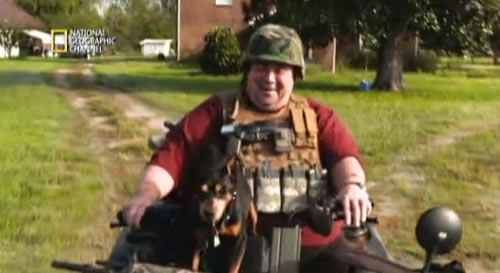
If you are a disabled vet as you claim, then you are probably collecting VA/disability, so your self-sufficiency is being subsidized by the government that you are so clearly fearful of and hate (some patriot you are - you sound more like a traitor or terrorist).
One with nature...
...as you winter in the wilderness, clutching your nature-grown guns and ammunition, living and feeding off of supplies that you purchased and packed in.
Yeah, you're a veritable Mr Natural:

ADGComment
 he stuffed the bear its a fucking huge thing.





Comment