Quote:
Originally Posted by DeadFidel

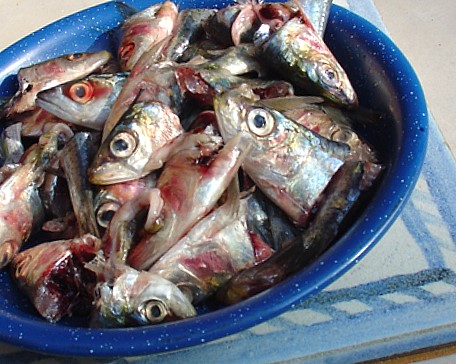
ADG...put the fishheads in olive oil and garlic overnight. Then deep fry them until crispy.
Dip in horseradish for a real treat. Really 
 |
Horseradish = Wasabi
Pretty sure that I have had that a time or three...
Quote:
Originally Posted by Redrob
Think of Japanese grammar as a freight train with the engine as the verb pushing the train. Just lock on the different parts of the sentence and line them up in order of importance. Put wa on the topic, ga on the subject, o on the object, de how it is happening, ni on when it is happening, e on direction to, kara on direction from, etc...
I am going to Tokyo from Osaka by train tomorrow.
Watakushi wa (I) ashita ni (tomorrow) densha de (by train) Tokyo e (to Tokyo) Osaka kara (from Osaka) ikimasu ( am going). Note. the Japanese leave off the I/you part unless it is not understood from the context of the conversation.
My Japanese is rusty. Gomen.
|
Yeah, that's basically it for conversational Japanese.
Written Japanese is a whole different crazy matter, as their syllabary, depending on which system you use, consists of nearly 100 characters for proper Japanese - Hiragana - and nearly an equal amount for Katakana (mostly to designate foreign or scientific terms).
If you want to read and write proficiently enough to understand a newspaper, then in addition, you must learn several thousand kanji (Chinese characters, which are pronounced differently than the Chinese characters, and often have more than one context sensitive meaning).
That is why, Japanese and Chinese students, in addition to spending several more hours per month, and more months per year in class than Americans, have the equivilant of a college education by the time most Americans have barely a high school education.
And keep in mind that the standards for admissions to the top instiitutions in Japan and China are much higher than in the U.S.
Just remember: A riddle language goes a wrong way...

ADG